.svg)





There is a persistent idea that the Cotswolds is best visited in summer — when cottage gardens are in full bloom and the stone villages glow warmly in the long evening light. That idea is not wrong, exactly. But it is incomplete. Autumn transforms the Cotswolds in ways that summer simply cannot, and for travellers who take their short breaks seriously, September through November is the season to finally make the journey.
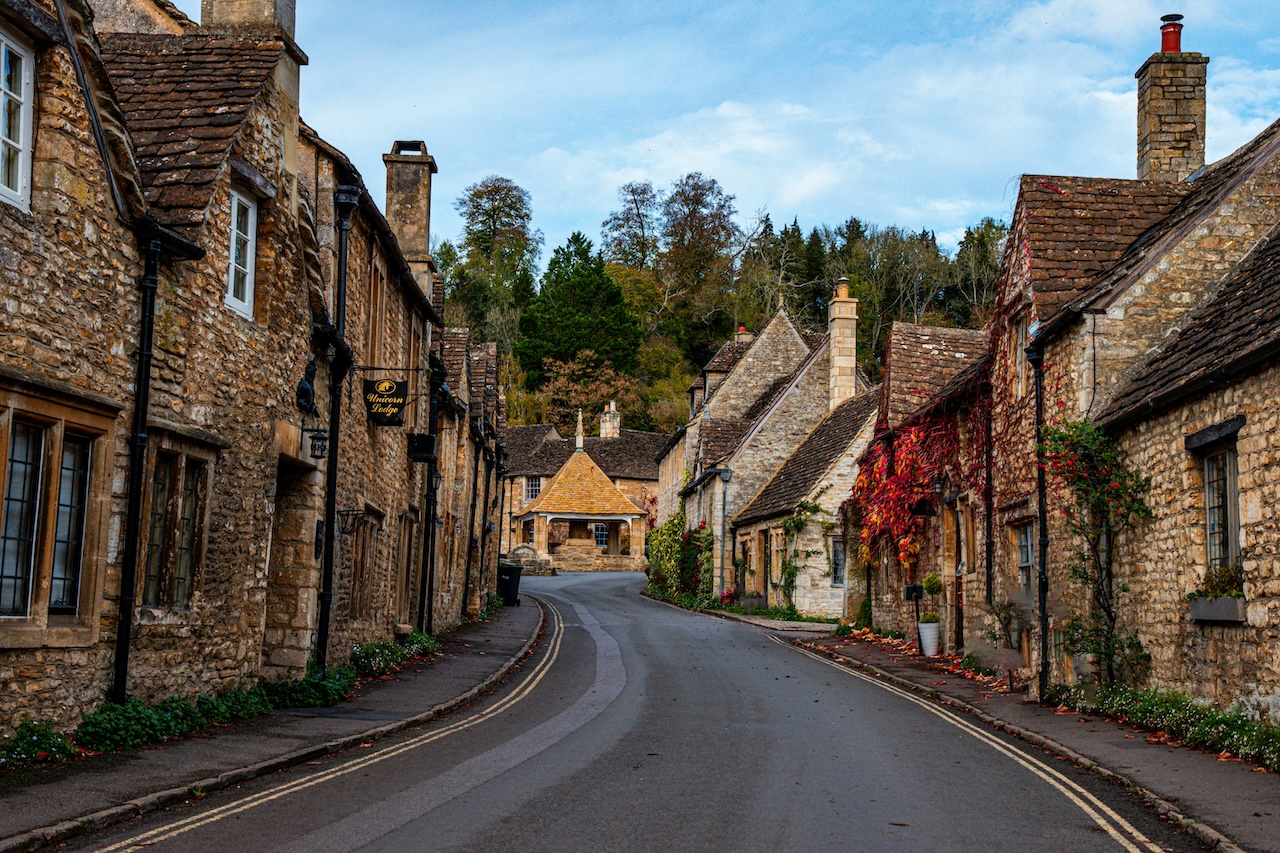
The calculus is straightforward. Visitor numbers drop, accommodation prices follow, the roads clear, and the landscape goes through a change that requires no prior knowledge of architecture or history to appreciate. The beech woodlands turn amber and copper, morning mist settles in the valleys, and the honey-coloured stone of every village seems to absorb and amplify the season's palette. This is the Cotswolds at its most atmospheric — and, crucially, at its most accessible.
Why Autumn Transforms the Cotswolds
The Cotswolds is, at its heart, a landscape of light and stone. In summer, that light can be harsh at midday, flattening the texture of the villages and reducing what should be a layered, subtle experience to something closer to a film set. Autumn changes this fundamentally.
The low-angle sun of September and October casts long shadows across the limestone walls, picks out the texture of old market towns and brings a warmth to even overcast mornings. The famous beech hangers — stretches of mature woodland on the escarpment — turn from green to every shade of rust and gold between mid-October and early November, making Cleeve Hill, the Coln Valley and the area around Painswick genuinely spectacular for walkers. On a still October morning, with low cloud in the valley and the woodland above lit gold, the Cotswolds delivers a quality of beauty that no photograph prepares you for.
Beyond the visual, there is a practical dimension to autumn's appeal. The school-holiday crowds that define August in Bourton-on-the-Water and Burford have departed. Car parks have space before nine in the morning. Restaurants with month-long waiting lists in summer will often seat you with a day's notice. And a growing number of the region's better hotels offer midweek autumn rates that make a two-night stay considerably more accessible than in peak season. October in particular occupies a sweet spot: the foliage is at its finest, the weather can still be kind, and the region's food culture — game, wild mushrooms, orchard fruit — is at its most interesting.
For travellers who want to engage properly with a place — its food, its landscape, its pace — autumn is unambiguously the right moment to go.
The Best Villages to Base Yourself In
The question most first-time visitors get wrong is which village to use as a base. The instinct is often to head for the most famous names — Bourton-on-the-Water, Chipping Campden, Stow-on-the-Wold — and all three have genuine merit. But treating them as destinations in their own right, rather than as bases for a wider exploration, tends to produce a more satisfying trip.
Burford makes an excellent case as a headquarters. It sits at the eastern edge of the Cotswolds proper, has a strong independent high street, several very good restaurants and a range of accommodation from boutique inns to private cottages. It is also within easy reach of Bourton, Northleach and the Windrush valley, which means a car-based itinerary fans out in every direction without long drives. The medieval church of St John the Baptist alone justifies an extended stop.
Painswick, on the escarpment south of Cheltenham, is the choice for those who want something quieter. Known as the Queen of the Cotswolds, it has fewer tourists than its neighbours and one of the finest churchyards in England — ninety-nine ancient yew trees clipped into rounded forms that have been here for centuries. The Painswick Rococo Garden, unusual in that it survived largely intact, is worth half a day in October when the kitchen garden is still productive and the canopy turns. The village also has excellent walking directly from the door, including the Cotswold Way long-distance trail.
Chipping Campden anchors the northern Cotswolds and is arguably the most complete medieval wool town remaining in England. Its High Street, built almost entirely in the seventeenth century, requires no enhancement from the tourist board to impress. From here, the Vale of Evesham is a short drive, and Broadway — a village that knows it is beautiful and has arranged itself accordingly — is just a few miles south. The drive between the two along the back lanes in late October is, by most accounts, outstanding.
Where to Eat and Stay Well
The Cotswolds has long had a reputation for good food, and that reputation has only strengthened in recent years as independent operators have raised the bar on what a country gastropub can deliver. In autumn, foraging informs the menus in a way that summer's soft-fruit focus does not — expect game, wild mushrooms, heritage squash, cider-braised pork and robust, warming cooking built around the produce of the surrounding farmland.
The Wheatsheaf in Northleach is consistently regarded as one of the region's best gastropubs with rooms, offering a combination of unfussy cooking and individually styled bedrooms that represents good value by Cotswolds standards. For something more formal, Lords of the Manor near Bourton-on-the-Water has maintained its position as a benchmark property — a seventeenth-century manor house with a kitchen that has retained serious credentials and grounds that are particularly beautiful in autumn colour.
For self-catering, a number of specialist agencies handle Cotswolds cottages at the better end of the market. An autumn booking in a well-appointed stone cottage with an open fire or log-burning stove, and ideally a garden that backs onto farmland or woodland, is among the more reliably satisfying short-break formats Britain offers. The combination of reading, walking and eating well in a properly comfortable base is, by the accounts of those who return annually, extremely difficult to improve upon.
Practical Tips for Getting There and Around
The most convenient rail approach to the Cotswolds is via Kingham station, served by GWR from London Paddington in around an hour and twenty minutes. Moreton-in-Marsh also has a direct line from Paddington and provides a useful gateway to the northern Cotswolds villages. Both are useful arrival points, though the rail network's coverage of the interior is limited, and a car remains the most practical way to move meaningfully between villages.
If driving from London, the A40 via Oxford is the most direct route to the central Cotswolds; the M40 and then A44 serves the northern section well. Allow considerably more time than the map suggests on arrival — the lanes between villages are narrow and unhurried, which is precisely the point, and the pleasure of taking the wrong lane and discovering an unmarked hamlet is one the Cotswolds reliably provides.
For property visits, the National Trust's Cotswolds portfolio includes Hidcote Manor Garden and Snowshill Manor, both of which transition beautifully into the autumn season. Hidcote in particular is worth visiting in October for its kitchen garden and the extraordinary structure of its topiary rooms. The Cotswolds Tourism official guide remains the most comprehensive planning resource, covering walking routes, events, markets and accommodation across the entire Area of Outstanding Natural Beauty.
A short break of three nights midweek gives enough time to cover three or four villages at a considered pace, walk at least one good trail and eat well on each evening. That, in essence, is what the Cotswolds in autumn is for — and why those who experience it in this season so rarely go back to any other time of the year.

.jpg)



.svg)