.svg)





There is a common assumption that travel is primarily a pursuit of the young — that the best experiences require the energy, flexibility and lack of domestic obligation that life beyond thirty-five tends to complicate. This assumption is, in the direct experience of most people who travel seriously and consistently, comprehensively wrong.
Travel after forty is better. Not marginally, not in the consoling sense of finding silver linings — but genuinely, measurably, qualitatively better. The reasons for this are not difficult to understand once articulated, but the travel industry has been slow to communicate what experienced travellers know from their own lives: that the journeys that matter most, the ones that genuinely change the way you see the world, are frequently the ones taken with the perspective, resources and emotional readiness that forty and beyond tends to provide.
How Travel Priorities Shift in Midlife
The shift in travel priorities that typically accompanies the transition from the twenties and early thirties to the mid-forties and beyond is consistent enough to describe with some confidence, even if the specifics vary by individual.
The instinct toward quantity — more countries, more stamps, more overnight buses, more hostels, more days squeezed into the same calendar slot — gives way to something more considered and more personally authentic. The destination matters more, and the choice of it is less driven by the consensus of travel recommendations and more by genuine personal curiosity. The quality of the place to stay matters more — not as status or extravagance, but because the experience of waking up in a well-designed room that reflects its location, eating breakfast that connects to the place you are in, and having a base that functions as part of the journey rather than a logistical necessity, changes the quality of everything that happens during the day.
The food matters more — not because you have become precious about it, but because you have accumulated enough experience of eating well, locally and without haste, to know that it is one of the most reliable pathways into understanding a place. The conversation with a knowledgeable local guide in front of a building that has absorbed five centuries of history produces a different quality of experience at forty-five than it did at twenty-five, not because you were incapable of appreciating it earlier, but because the frame of reference you bring to it now is richer, the questions you ask are better and the connections you make between what you are seeing and what you have read and experienced before are more numerous and more interesting.
There is also a straightforwardly practical dimension. The resources available to travel — financial, in terms of the confidence to book something ambitious and manage complexity, and in terms of the self-knowledge to understand what you actually enjoy rather than what you feel you ought to enjoy — tend to increase with age in a way that directly improves both the range and quality of what becomes possible.
The Destinations That Work Better When You're Ready for Them
There are certain destinations that appear consistently in travel writing as aspirational and yet, in practice, require a particular readiness — a depth of context, a patience with complexity, a willingness to be confused and to sit with that confusion rather than retreating from it — to fully appreciate.
Japan is the most frequently cited example among serious travellers of a country that improves with the age and preparation of the visitor. Its extraordinary internal logic — the compression of ancient ritual and hypermodern technology in the same block, the weight of ceremony in the smallest gestures of service, the relationship between landscape, architecture and the way a garden is designed to be experienced across time — rewards visitors who have enough background knowledge to understand what they are seeing and enough patience to let the country's sensibility reveal itself rather than imposing their own expectations upon it. The traveller who arrives in Japan at forty-five, having read properly, having prepared themselves to be patient with confusion and to treat that confusion as information rather than failure, has a categorically different experience from one who arrived at twenty-two following a highlights itinerary.
India is perhaps the most complex travel destination in the world, and the relationship most serious travellers have with it tends to improve significantly over time and across multiple visits. The scale, the density of sensation, the simultaneous beauty and difficulty — these require a degree of equanimity and genuine curiosity that experience provides. Many travellers who find India overwhelming or confusing at twenty-five discover at forty that they were simply not ready for it, and that the same places — Varanasi at dawn, the abandoned city of Fatehpur Sikri, the lake palaces of Rajasthan — now produce something closer to deep recognition than bewilderment.
The American South — the Delta blues heritage of Mississippi, the food culture of New Orleans, the mountain communities of Appalachia — is a region that rewards travellers who arrive with an understanding of its specific history and a curiosity about the relationship between that history and the present. It is not a destination that yields its depth to the disengaged visitor. It is, for those who engage with it properly, one of the most culturally complex and rewarding regions in the world.
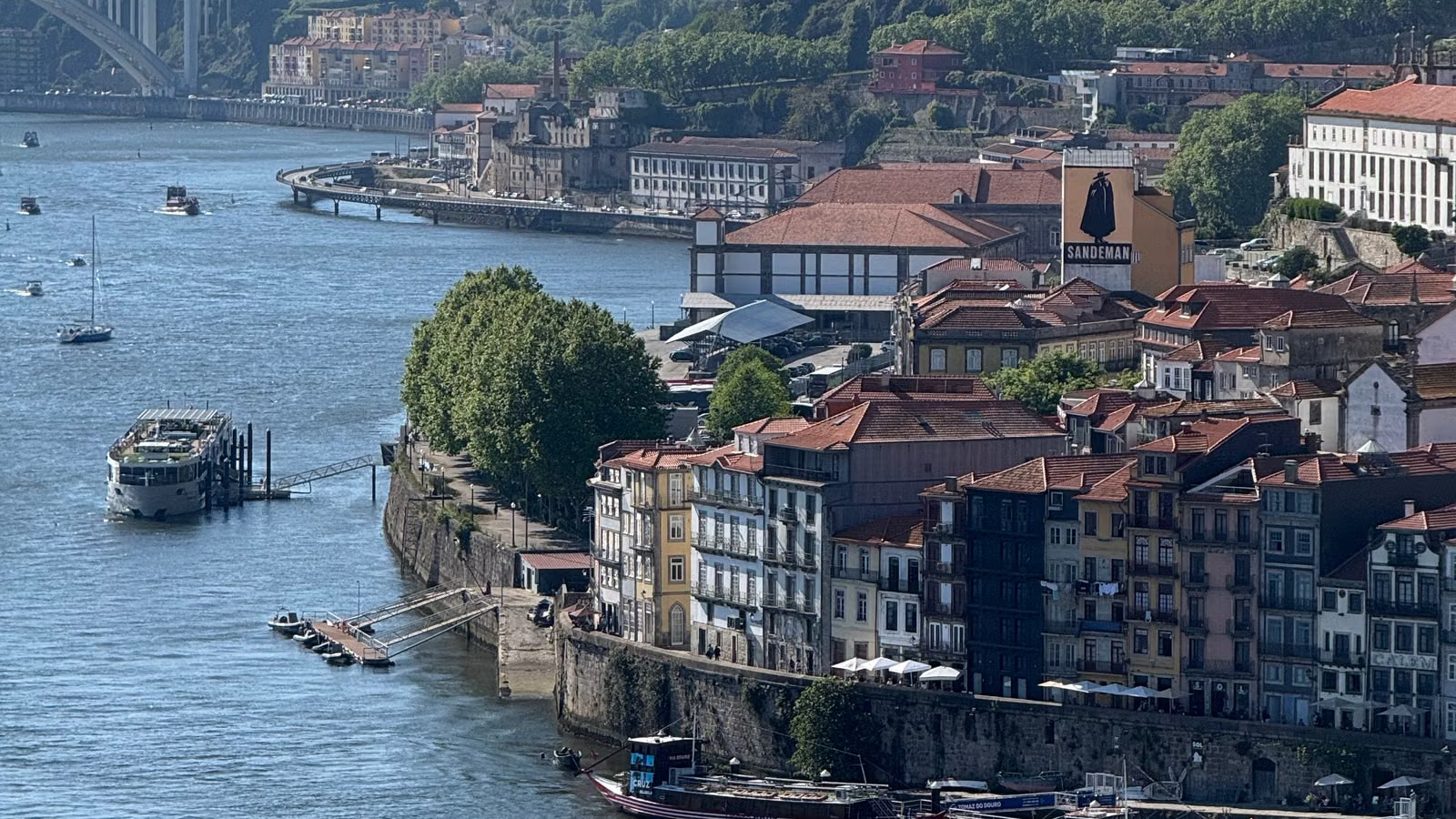
Northern Spain, the coast of Portugal, southern Italy — slower, food-centred, culturally layered destinations where the pleasure is fundamentally about being present rather than accumulating — consistently produce their most positive experiences in travellers who have moved past the need to demonstrate productivity with a dense schedule of sights.

Travelling at Your Own Pace: Practical Implications
One of the most significant practical advantages of travel beyond forty is the freedom — in many cases for the first time — to travel genuinely at one's own pace, unconstrained by a companion's different priorities, a package itinerary's fixed schedule, or the anxiety of making the most of a budget that permits no flexibility.
This means arriving in a city with two full days of nothing specifically planned. It means finding the best local restaurant on the first evening and returning on the third. It means taking the overnight train across a country rather than flying, because the journey itself — the compartment, the landscape in the early morning, the conversation with a fellow passenger — is part of what makes travel worthwhile. It means changing the plan when something unexpected presents itself — a festival, a conversation, a weather window that opens a walk — without the anxiety that the overprogrammed itinerary produces.
The planning template for travel after forty should be built around this pace as a first principle rather than accommodated reluctantly. Fewer destinations. More time at each. The hotel that costs slightly more and has a terrace that is worth occupying for two hours with a coffee in the morning. The guide who is engaged for two days rather than two hours.
Why Experience Matters More Than Distance Covered
The metric by which travel is often implicitly measured — countries visited, continents covered, miles logged — is one of the first things to fall away when travel stops being a performance of having travelled and becomes a genuine engagement with the world.
The traveller who has been to forty countries but cannot describe a single specific afternoon in any of them with genuine vividness or pleasure is, in a meaningful sense, less experienced than one who has been to twelve and can tell you exactly what the light was like in the square of a particular Portuguese town at six o'clock on an October evening, why it stopped them mid-step, and what they understood about the place in that moment that they could not have understood from a guidebook.
ABTA's research on travel behaviour consistently documents a shift toward quality over quantity in the forty-plus traveller demographic, with longer stays, higher per-day investment and a strong preference for independent and specialist itineraries over packaged volume travel. SAGA Travel's destination portfolio provides practical inspiration and specialist knowledge for this demographic. The best journeys are not behind you. For most people who travel thoughtfully, they are still ahead.

.jpg)

.jpg)


.svg)