.svg)





The first thing to understand about planning an African safari is that Africa is not a safari destination. It is a continent of fifty-four countries, ecosystems ranging from equatorial rainforest to hyper-arid desert, and wildlife scenes of extraordinary variety and often radical contrast. The Masai Mara is not the Okavango Delta is not Kruger is not the Serengeti — each is a distinct proposition shaped by different ecology, climate, infrastructure and wildlife character. Choosing between them on the basis of magazine photography alone is among the most common planning errors a first-timer makes.
The second thing to understand is that a great safari is not primarily about which animals you see, but the intelligence of the viewing experience: the expertise of the guide, the timing and positioning of the vehicle, the choice of activity type and the quality of the lodge that structures the experience around the game drives. The difference between an outstanding guide and a mediocre one is, in practical terms, the difference between understanding what you are watching and merely watching it. Getting to the outstanding option requires good planning decisions made well in advance of departure.
East Africa vs Southern Africa: Key Differences
The distinction between East Africa and Southern Africa is the most important planning decision a first-timer faces, and it is emphatically not a matter of one region being better than the other — they offer fundamentally different experiences that suit different interests.
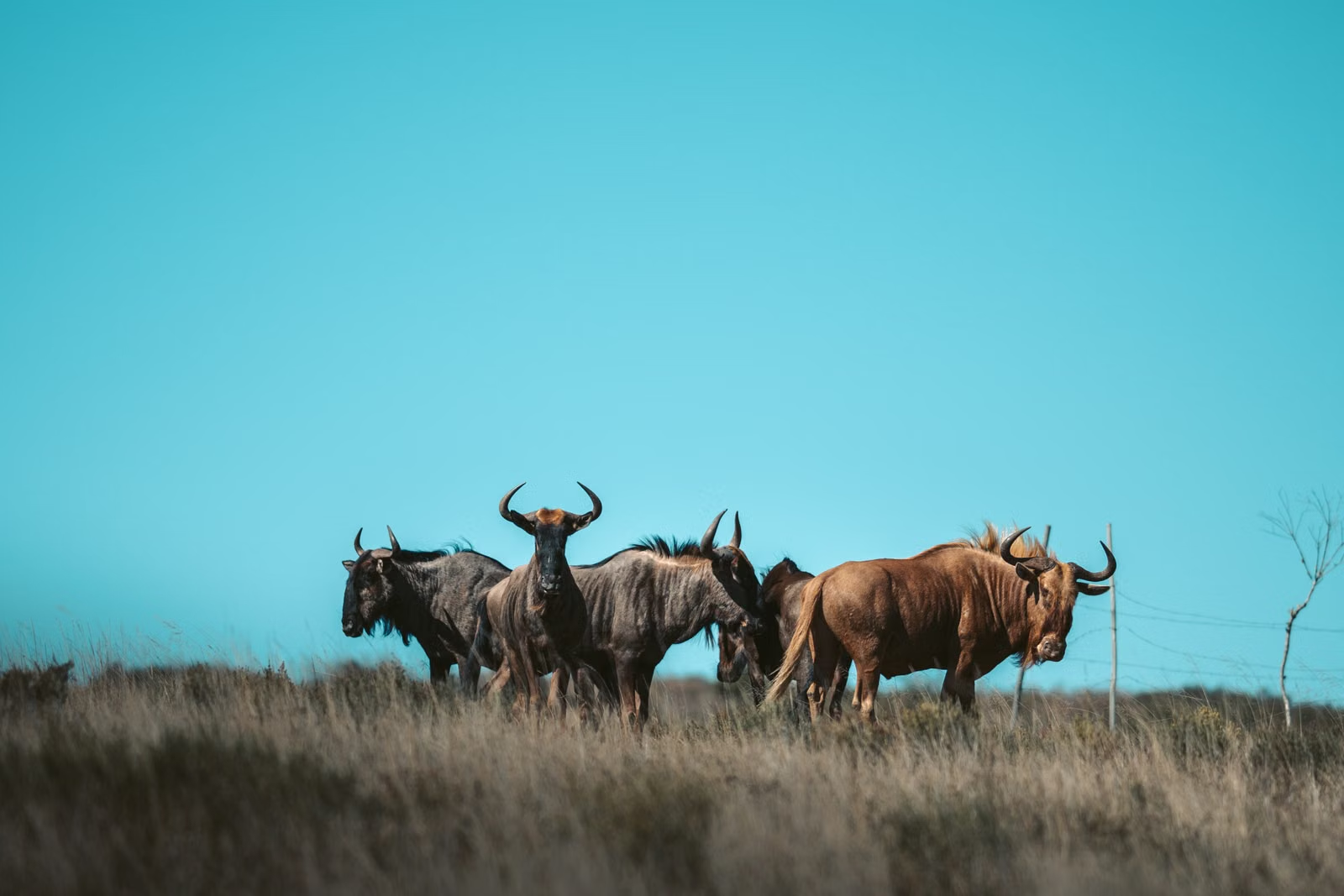
East Africa — primarily Kenya and Tanzania — is the landscape of the great wildebeest migration, the largest overland movement of wild animals on earth. It is the landscape of the Masai Mara, the Serengeti's vast plains, the ancient caldera of Ngorongoro, the ambush photography of Amboseli with Kilimanjaro behind the elephant herds. Wildlife densities in the right season and location are extraordinary: large lion prides with many individuals, elephant families of fifty or more, cheetah families working the open grassland in combination. The classic East African safari is often a fly-camp format — light aircraft between bush airstrips connecting remote tented camps — which adds a dimension of immersion that the ground-transfer model does not replicate.
Southern Africa — primarily South Africa, Botswana, Namibia and Zimbabwe — offers a wider range of terrain and of experience format. South Africa's Kruger National Park is the most logistically straightforward introduction to self-drive safari travel, with a road network that functions reliably, accommodation ranging from National Parks rest camps to premier private lodges, and the full Big Five reliably viewable across its two-million-hectare extent. Botswana's Okavango Delta is an entirely different landscape proposition — a water-based safari world of mokoro canoes, boat safaris through papyrus channels and walking safaris across floodplains that support extraordinary concentrations of wildlife in the dry season. Namibia offers a desert landscape of singular visual drama, with wildlife adapted to arid conditions: desert-adapted elephants navigating the Skeleton Coast ephemeral rivers, black rhino in the Damaraland concessions, and a night sky in the Namib that constitutes, in itself, one of the natural world's great spectacles.
Understanding Wildlife Seasons and Migration Timing
Wildlife viewing quality is not consistent year-round, and timing the safari to the most productive season for the chosen destination is among the highest-leverage planning decisions available.
In Kenya and Tanzania, the wildebeest migration follows a broadly predictable annual circuit driven by rainfall patterns and grazing availability. The southern Serengeti's Ndutu region holds the calving herds from December through March — one hundred thousand calves born in a matter of weeks, and the predator concentration this produces is extraordinary. The migration moves north through April and May, arriving in the Masai Mara for the river crossings — where columns of wildebeest and zebra descend the banks of the Mara River with Nile crocodiles in attendance — from July through October. The crossings are unpredictable in their timing, happen multiple times each day at peak season, and are one of wildlife tourism's most reliably spectacular events.
In Southern Africa, the dry season from May through October concentrates wildlife around permanent water sources as the bush thins and visibility increases. This period is universally considered prime game viewing across Kruger, Botswana and Zimbabwe. The wet season (November to April) offers a counter-intuitive appeal: the landscape is verdant and dramatically lit, bird life is exceptional (many migratory species are present), and accommodation rates at many lodges are meaningfully lower. For photographers, the diffuse light of overcast wet-season mornings produces some of the finest conditions available.

Game Reserve vs National Park: What to Know
The distinction between a national park and a private game reserve or conservancy is among the most important and least understood variables in safari planning, and it significantly affects the quality of the game drive experience.
National parks are public land. Any registered operator's vehicle can occupy the same sighting simultaneously. In the Masai Mara during peak migration, a successful cheetah hunt or lion kill can attract ten or more vehicles within minutes. The wildlife is identical; the experience of watching it through a crowd of vehicles is not.
Private reserves and conservancies — land managed in conjunction with national parks but under private or community ownership — restrict access to vehicles from registered operators with specific concession rights. Vehicles are limited per sighting; off-road driving (prohibited in national parks) is permitted to position for the best view; and night drives, which open the nocturnal wildlife world of leopard, hyena and smaller predators, become available. The private concessions in Botswana's Okavango and the Chobe region, and South Africa's famous Sabi Sand and Timbavati reserves adjoining Kruger, consistently rank among the finest game viewing experiences in the world for precisely these reasons. The per-night rate is higher than national park accommodation; the quality of the experience justifies the difference for those who can plan accordingly.
Choosing an Operator, Lodge Grade and Budget Range
The safari market spans a remarkable range, from budget mobile camping expeditions to ultra-luxury private concession camps where the ratio of staff to guests, the quality of the vehicles and the expertise of the guides place the experience in an entirely different category. For a first safari, working with an established safari specialist — rather than a general-purpose travel agent — is strongly recommended. The expertise required to match the right destination, the right season, the right lodge grade and a coherent routing to a specific traveller's profile is considerable.
Responsible practice should be a primary criterion in operator selection. Wildlife tourism has a direct and measurable relationship with conservation outcomes; the fees paid to the best operators fund anti-poaching operations, habitat protection and community benefit programmes that underpin the long-term viability of the wildlife populations the safari depends on. Responsible Travel's safari guide provides practical criteria for assessing operator credentials and lodge sustainability practices. Rhino Africa's planning resources offer detailed destination, lodge and timing information that provides a well-researched starting point for the pre-booking research phase.
A first African safari is, for a high proportion of those who undertake it, a travel experience they describe as among the most significant of their lives. The planning decisions made before departure — destination, season, lodge grade, guide quality, activity range — are the primary determinant of whether that description accurately reflects what they experience.



.svg)